How to Remove Hard Water Stains in St. Louis
St. Louis tap water is among the hardest in the Midwest. Calcium and magnesium deposits build up on shower glass, faucets, and stone surfaces faster here than in most U.S. cities — and standard cleaning does not fully remove them. Here is how mineral deposits form, which surfaces they damage most, and how professional 275°F steam treatment removes them without harsh acids.
Quick Answer
Hard water stains in St. Louis homes are calcium and magnesium carbonate deposits left behind as tap water evaporates. Light deposits on glass and faucets respond to acid-dwell DIY methods. Heavy deposits on shower glass, natural stone, and cast iron require 275°F steam treatment to break the mineral bonds without risking surface damage.
| Surface Type | Deposit Type | Treatment Temperature |
|---|---|---|
| Shower glass / chrome faucets | Calcium carbonate film | 275°F steam (thermal fracture) |
| Limestone / travertine countertops | Calcium + magnesium compound | 275°F steam only (no acid) |
| Cast iron fixtures / tubs | Iron-calcium scale | 275°F steam + extraction |
Why St. Louis Tap Water Leaves Stains
St. Louis municipal water draws from the Missouri and Mississippi Rivers. Both carry elevated concentrations of dissolved calcium and magnesium from the limestone and dolomite geology of the upstream watershed. Water hardness in the St. Louis metro typically ranges from 150 to 250 milligrams per liter — roughly two to four times the threshold at which visible mineral deposits begin forming on household surfaces.
The mechanism is straightforward: water arrives at your faucet carrying dissolved minerals. When it evaporates — from a shower wall, a faucet base, a countertop edge — the water vapor escapes but the calcium and magnesium remain behind as solid carbonate crystals. Each evaporation event leaves a thin mineral layer. Over weeks and months, those layers accumulate into the white, chalky, or rust-tinted deposits that resist standard wipe-down cleaning.
St. Louis's humidity compounds the problem. During summer months, when relative humidity routinely exceeds 75%, water on bathroom surfaces evaporates more slowly — meaning it sits on the surface longer, depositing a higher concentration of minerals per event. Homes near Forest Park and along the Missouri River corridor in Chesterfield often report faster visible staining than homes in drier microclimates west of I-270.
Surfaces Most Affected in St. Louis Homes
Not all surfaces accumulate mineral deposits at the same rate or severity. Our Certified Cleaning Specialists see a consistent pattern across Clayton townhomes, Kirkwood craftsman bungalows, and Chesterfield new-construction homes:
Shower glass and frameless enclosures
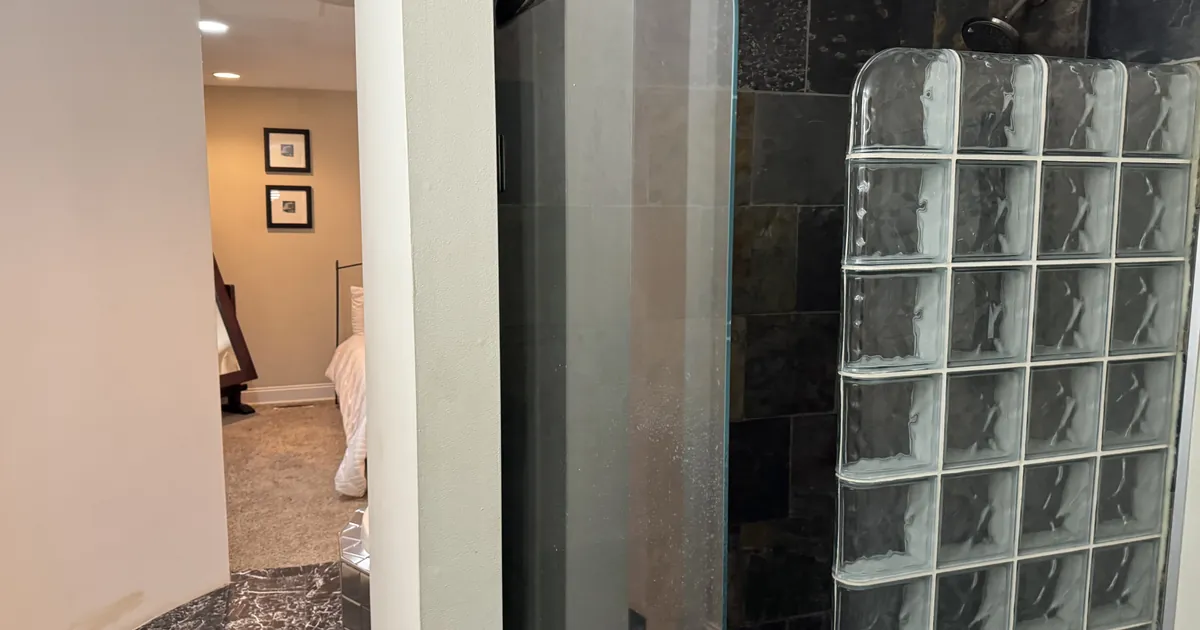
Glass is the highest-accumulation surface in any bathroom. Water sheets across the entire pane with every shower, then evaporates — leaving mineral film across the full glass area. Frameless shower enclosures in Ladue and Town and Country properties, where glass spans floor to ceiling, are particularly vulnerable because there is no grout joint or trim to interrupt the deposit zone.
Chrome and brushed nickel faucets
The base and spout of bathroom faucets accumulate a crusty white ring of calcium carbonate at the waterline — the zone where water sits and evaporates repeatedly. Brushed nickel is particularly visible because the texture traps mineral particles in the grain of the finish. For related guidance on bathroom surfaces, see our St. Louis bathroom deep cleaning guide.
Limestone and travertine countertops
Natural stone countertops are chemically reactive with both hard water deposits and the acid-based cleaners commonly used to remove them. Limestone and travertine — popular in St. Louis kitchen and bathroom renovations — will etch visibly if vinegar or citric-acid solutions are applied. Mineral deposits on these surfaces require steam-only treatment.
Cast iron fixtures and clawfoot tubs
Older St. Louis homes in Webster Groves and Kirkwood frequently retain original cast iron tubs and pedestal sinks. These surfaces develop iron-calcium composite scale — a harder, rust-tinted deposit that requires both thermal treatment and mechanical extraction. The porcelain enamel coating on cast iron is brittle; abrasive scrubbing risks chipping it permanently.
How 275°F Steam Removes Mineral Deposits
The chemistry of hard water stain removal with steam works through sudden temperature change. Calcium carbonate deposits are crystalline structures with a specific thermal expansion coefficient. When a 275°F steam jet contacts a deposit, the rapid temperature increase causes the crystal lattice to expand faster than the surface it is bonded to — micro-fracturing the deposit along its boundary with the glass, stone, or metal below.
This is why steam is effective on surfaces where acid-based cleaners are unsuitable. The thermal mechanism does not require a chemical reaction with the mineral — it physically detaches the deposit from the substrate. No acid residue is left on stone surfaces, no corrosive contact with chrome finishes, and no harsh solvent contact with grout or caulk.
The 3-step professional process:
- 1
Pre-assessment. Our Specialist identifies the surface material and deposit age. Older deposits may require a longer steam dwell time; cast iron and stone surfaces dictate no-acid protocol regardless of deposit severity.
- 2
Steam application. 275°F steam is applied in controlled passes across the deposit zone. The steam both fractures the mineral layer and drives moisture into micro-cracks in the deposit, expanding them further. On glass surfaces, a squeegee pass immediately after steam contact removes loosened mineral material before it redeposits.
- 3
Extraction and wipe-down. Loosened mineral particles are extracted or wiped with a clean microfiber cloth. On stone surfaces, a second pass of steam ensures no mineral residue is left in pores. The surface is then inspected under direct light to confirm complete removal.
Professional vs. DIY Hard Water Treatment
DIY approaches work in specific circumstances and fail in others. Here is an honest comparison:
When DIY works
- —Light deposits (less than 4 weeks of accumulation) on chrome or coated glass
- —Undiluted white vinegar dwell (15–30 minutes) on chrome faucet bases
- —Citric acid solution on ceramic tile grout lines (not natural stone)
- —Weekly squeegee on shower glass immediately after each use — prevents accumulation from forming
When DIY fails
- —Heavy deposits on shower glass (6+ weeks without treatment) — acid dwells alone cannot fully penetrate the layered structure
- —Any natural stone surface — acid etches permanently
- —Cast iron fixtures — abrasive scrubbing risks enamel chips
- —Iron-calcium composite scale — requires steam plus mechanical extraction, not acid alone
For the full scope of what professional deep cleaning addresses in bathrooms beyond hard water treatment — grout, caulk, exhaust fans, and tile — see our bathroom deep cleaning guide for St. Louis. For understanding which service level addresses mineral deposits as part of a full home clean, the deep cleaning versus standard cleaning comparison covers scope differences clearly. Baseboard accumulation — a secondary mineral deposit zone — is addressed in our baseboard cleaning guide.
Common Areas We Treat in Clayton, Kirkwood, and Chesterfield
Our Certified Cleaning Specialists serve the full St. Louis metro with a consistent 275°F steam protocol for mineral deposit treatment. The character of the work varies by neighborhood and home era:
- —
Clayton and Ladue — newer high-rise condos and post-2000 renovations with frameless glass shower enclosures and polished natural stone. The primary treatment areas are floor-to-ceiling shower glass and limestone vanity countertops.
- —
Kirkwood and Webster Groves — pre-war homes with original cast iron clawfoot tubs and pedestal sinks. Iron-calcium composite scale is common here; the no-abrasive, steam-extraction protocol protects original enamel finishes.
- —
Chesterfield and Creve Coeur — 1990s–2000s construction with ceramic tile showers and chrome faucet packages. Grout lines accumulate a mineral-soap composite that benefits from steam treatment before recurring maintenance begins. Our move-in cleaning service for this area typically addresses significant accumulated deposits in prior-occupant bathrooms.
- —
Town and Country and Ballwin — estate and luxury properties where hard water treatment is part of a larger deep cleaning service that addresses every wet zone in the home. Multiple bathrooms, wet bars, and outdoor kitchen areas all require mineral deposit treatment on the same visit.
Regardless of neighborhood, the underlying chemistry is the same: Missouri River mineral content creates consistent deposit profiles across the metro. What varies is the surface type and deposit age, which determines protocol selection.
About the Author
I'm Jason Ellis, Operations Director at Clean Town & Country. We are a family-owned residential cleaning service based in St. Louis, $2M insured, with background-checked Certified Cleaning Specialists. The mineral deposit treatment protocol described here is what our team applies across Clayton, Kirkwood, Chesterfield, and the wider metro. We have treated hard water deposits on every surface type common in St. Louis homes — from original cast iron tubs in Webster Groves pre-war properties to frameless glass enclosures in Ladue renovations.
The consistent finding: deposit age is the primary variable that determines outcome. Light accumulation responds to a single steam treatment. Deposits older than several months — especially on natural stone — sometimes require two treatment passes to achieve full removal. Establishing a recurring cleaning cadence after the initial treatment prevents that degree of accumulation from returning.
Frequently Asked Questions
Why does St. Louis water leave so many mineral stains?
St. Louis municipal water draws from the Missouri and Mississippi Rivers, both of which carry elevated calcium and magnesium concentrations. Water hardness in the metro ranges from 150 to 250 milligrams per liter — two to four times the threshold that begins producing visible mineral deposits. Summer humidity accelerates the effect by slowing evaporation and increasing mineral concentration per drying event.
Can vinegar remove hard water stains from shower glass?
Diluted white vinegar can soften light calcium carbonate deposits on shower glass when applied and allowed to dwell for 15–30 minutes. It is not effective on heavy or long-established deposits. It should never be used on natural stone surfaces — the acidity will etch limestone, marble, and travertine. For moderate to heavy build-up, or any stone surface, 275°F steam treatment is safer and more effective.
How does 275°F steam remove hard water stains?
Steam at 275°F delivers thermal energy that breaks the ionic bonds in calcium and magnesium carbonate deposits. The rapid temperature differential causes micro-fracturing of the mineral crust, loosening it from the surface below without acid-based chemical intervention. The loosened deposit is then wiped or extracted — leaving surfaces clean without chemical residue.
How long does it take for hard water stains to form on shower glass?
In St. Louis tap water conditions, visible mineral haze on uncoated shower glass typically develops within 2–4 weeks of regular use. The rate accelerates in summer months. Glass with a factory hydrophobic coating can extend this to 6–8 weeks, but no coating eliminates mineral deposit formation entirely.
Do hard water stains permanently damage surfaces?
Untreated for extended periods, hard water deposits can cause permanent etching on natural stone and glass. On limestone and travertine, mineral deposits interact with stone chemistry and can leave pitting not reversible by cleaning. On shower glass, calcium carbonate baked in by heat over months can bond at a molecular level, requiring abrasive polishing to remove. Early and regular treatment prevents this outcome.
Clean Town & Country
Remove Hard Water Stains in Your St. Louis Home
Background-checked Certified Cleaning Specialists. Family-owned St. Louis service. $2M insured. Satisfaction guaranteed. We treat mineral deposits on shower glass, natural stone, cast iron, and faucet fixtures across Clayton, Kirkwood, Chesterfield, and the wider metro.
Insured & bonded • HEPA filtration • Satisfaction guaranteed