How to Deep Clean a Refrigerator: A St. Louis Home Guide
A step-by-step process for the refrigerator deep clean most households skip — including the condenser coils, door gasket, and drip pan that a surface wipe never reaches.
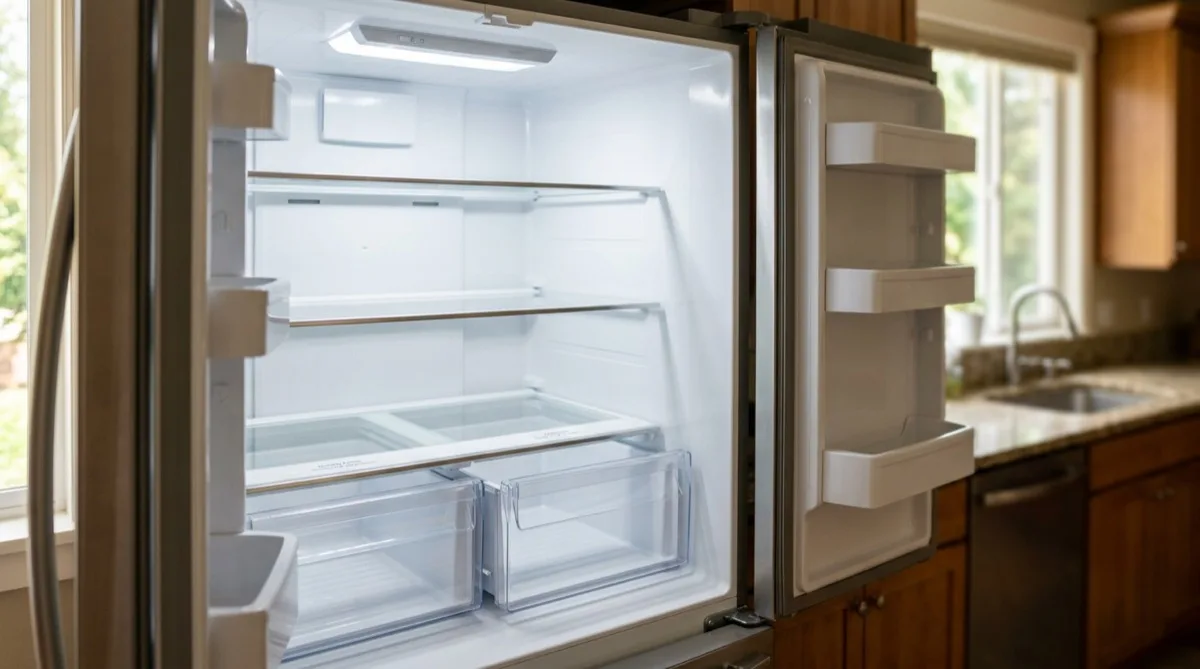
Quick Answer
To deep clean a refrigerator, remove all food and shelves, wipe every interior surface with a baking-soda solution, clean the gasket and condenser coils, then dry fully before restocking — plan for 60–90 minutes and repeat every 3–4 months.
| Factor | DIY | Professional |
|---|---|---|
| Typical time | 60–90 minutes | 20–30 minutes |
| Recommended frequency | Every 3–4 months | Every 3–4 months |
| Coil cleaning included | Rarely done | Yes, every visit |
Why Refrigerator Deep Cleaning Matters More Than You Think
In our experience cleaning St. Louis kitchens, the refrigerator is one of the most consistently neglected appliances in otherwise spotless homes. A weekly wipe of obvious spills is not the same as a true deep clean — the door gasket, the condenser coils beneath or behind the unit, the vegetable drawers, and the shelf edges all accumulate residue that a surface pass will never reach.
Beyond the aesthetic, a dirty refrigerator works harder. Clogged condenser coils force the compressor to run longer, which shortens the appliance's lifespan and raises your energy bill. For households in Ladue or Town and Country MO with high-end built-in or integrated panel-ready units, that extra wear on a premium appliance is worth taking seriously. Our guide on luxury kitchen appliance care in St. Louis goes deeper on appliance-specific care.
The good news: once you know the process, a full deep clean is systematic and repeatable. Here is exactly how our team approaches it.
Step-by-Step Process: How to Deep Clean a Refrigerator
Our cleaners follow this sequence on every deep clean visit. You can replicate it at home with standard household supplies.
Empty and sort all contents
Remove every item, placing perishables into a cooler with ice. This is a good moment to check expiration dates and consolidate half-used condiments. Our team regularly finds items tucked in back corners that have been there for months — a fresh inventory is part of the clean.
Remove and soak all shelves and drawers
Glass shelves, plastic drawers, and door bins come out completely. Soak them in warm water with a few tablespoons of baking soda for 10–15 minutes while you work on the interior. Use a soft-bristle brush — never abrasive pads — to avoid scratching surfaces. A microfiber cloth works well for the final wipe.
Scrub the interior walls, ceiling, and floor
Mix 2 tablespoons of baking soda per quart of warm water. Work from the top down, paying close attention to the back wall where condensation and spills accumulate. The ceiling panel and light housing are areas most DIY cleaners skip — our team never does. Dry thoroughly with a clean microfiber cloth before returning the shelves.
Clean the door gasket
The rubber door gasket accumulates residue in every fold. Use a toothbrush or narrow detail brush to work baking-soda solution into each crease. Wipe clean and dry completely. A damaged or compressed gasket reduces the seal and forces the compressor to overwork — worth inspecting every time you deep clean.
Vacuum and wipe the condenser coils
Locate the coils — usually behind a kick plate at the bottom front, or at the back of older models. Use a coil brush and vacuum with a narrow attachment to pull away accumulated dust. This step alone can meaningfully reduce energy consumption. It is the step most DIY cleaners never attempt, and the one our team never skips. Professionally, we pair this with 275°F steam on the external surfaces and door exterior for a complete finish.
For a room-by-room breakdown of what a full deep clean covers beyond the refrigerator, see our house cleaning checklist by room.
How Often Should You Deep Clean Your Refrigerator?
The right cadence depends on your household. A single person with modest cooking habits may get away with twice a year. A family of five in Chesterfield or Kirkwood who meal preps regularly should plan for every three months. At minimum, every four months is a sensible baseline for any household.
Between deep cleans, a quick monthly wipe of shelves and the top drawer with a damp microfiber cloth prevents buildup from compounding. If something spills, address it the same day — dried-on residue in a cold environment is far harder to remove.
Our broader guide on how often to deep clean your house walks through cadence recommendations for every major room, including the kitchen. If you are not sure whether your kitchen needs a full reset or a targeted touch-up, our deep cleaning vs. standard cleaning comparison breaks down exactly what each service covers.
Serving St. Louis Kitchens Across Every Neighborhood
Clean Town & Country is a family-owned St. Louis cleaning company, and our team works across the metro every week. From Forest Park-adjacent homes in Clayton and University City to larger estates in Frontenac and Town and Country MO, we see a wide range of kitchen layouts and appliance configurations.
In Webster Groves and Maplewood, we frequently work in older homes with original cabinetry and coil-style refrigerators that need particular attention to the back condenser panel. In newer builds in Ballwin and Chesterfield, panel-ready integrated units require a different approach to coil access and exterior cleaning.
Our background-checked cleaners bring $2M in liability coverage to every job, whether it is a kitchen refresh in Kirkwood or a full-home kitchen deep clean in St. Louis. Every clean is backed by our satisfaction guarantee — if something does not meet your standard, we come back.
Clean Town & Country
Rather Not Spend Your Weekend On This?
We handle standard, deep, and move-out cleaning across the St. Louis metro. Tell us about your home and we will send you a free quote — no obligation.
Insured & bonded • HEPA filtration • Satisfaction guaranteed
Frequently Asked Questions
Common questions from St. Louis homeowners about refrigerator deep cleaning.
How long does it take to deep clean a refrigerator?
A thorough DIY deep clean typically takes 45–90 minutes depending on fridge size and how long it has been since the last cleaning. Professional teams with commercial-grade equipment can often complete the job in 20–30 minutes.
How often should you deep clean a refrigerator?
We recommend a full deep clean every 3–4 months, with a quick wipe-down of shelves and drawers monthly. Households with children or frequent meal-prepping may benefit from doing it quarterly.
Can professionals clean built-in and panel-ready refrigerators?
Yes. Inside-the-fridge cleaning is a paid add-on, and we wipe built-in and integrated panel-ready units common in Ladue and Clayton homes with non-abrasive products. For specialized care, follow the maker's use-and-care guide.
What removes stubborn odors from a refrigerator?
Baking soda paste on drawer surfaces, combined with a thorough wipe-down of all interior walls and gaskets, addresses most odors. For persistent smells, activated charcoal left inside for 24 hours after cleaning is highly effective.
Is it safe to use steam inside a refrigerator?
Professional 275°F steam equipment is applied to exterior surfaces, gaskets, and removable components — not directly inside the cold compartment while it is running. Removable drawers and shelves are cleaned outside the unit, then returned once dry.
Ready for a Kitchen That Stays Cleaner, Longer?
Our family-owned St. Louis team brings background-checked cleaners, $2M in coverage, and a satisfaction guarantee to every home — from a single-appliance refresh to a whole-house deep clean.